
“I bought three yarn balls but ran out halfway,” or “I ended up with more than half left”—anyone who has made a crochet bag has probably made such a mistake at least once.
Crochet handbag yarn The required amount varies greatly depending on the bag’s size, shape, and yarn thickness. Buying based on intuition is risky.
In this article, we will explain the specific number of yarn yards required for making crochet bags. Tote bags, clutches, shoulder bags, and more, organized by design and size.
Additionally, the following topics are covered:
-
Formula for calculating yarn by gram
-
Common mistakes beginners often fall into when choosing materials
By reading this, you’ll be able to gather all the ingredients perfectly in one go. You can proceed without hesitation until your work is completed.
By Handbag Type and Size | Yarn Required Yardage Table
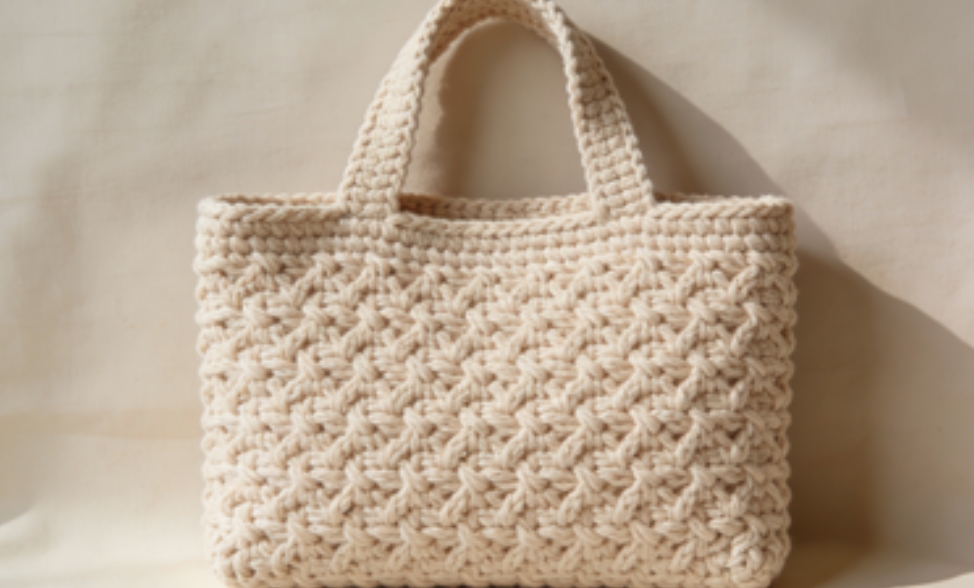
To check how many yarns a crochet bag yarn is, it’s best to work backward from the “bag type” and “size.” The following table summarizes the required yardage for each typical bag design. Please use this as a reference before purchasing any materials.
List of yarn required by bag type and size
|
Bag Types |
Estimated Finished Size |
Required yards (approximate) |
Required Meters (Approximate) |
|---|---|---|---|
|
Mini Clutch / Pouch |
Height 15cm × Width 22cm |
Approximately 190–250 yd |
Approximately 175–230m |
|
Small handbag |
Height 20cm × Width 28cm |
About 400–550 yd |
Approximately 365–500m |
|
Medium Tote Bag |
Height 28cm × Width 35cm |
About 700–900 yd |
Approximately 640–820m |
|
Large Tote Bag |
Height 35cm × Width 45cm |
Approximately 1,000 to 1,200 yd |
Approximately 915–1,100m |
|
Shoulder bag (with flap) |
Height 25cm × Width 30cm |
Approximately 550–750 yd |
Approximately 500–685m |
|
Marche bag (round bottom) |
Diameter: 20cm× Height: 25cm |
Approximately 600–800 yd |
Approximately 550–730m |
*All of the above are guidelines for using standard (DK–Worsted weight) cotton yarn and hooks 5–6. The values vary depending on the thickness of the yarn and the knitting method.
Calculation Basics: How to Convert to Number of Balls
If you wonder, “I know the handbag crochet yarn yardage, but how many should I buy?” you can solve it with a simple formula.
Required balls = Total required yards ÷ yards per ball
Let’s look at a concrete example:
-
Example (1): Want to make a medium tote bag (required amount approx. 820yd), yarn used per 150yd → 820 ÷ 150 ≈ 5.5 yarn → 6 yarn purchased
-
Example (2): When finishing a fluffy mini bag (100% acrylic, 35g/59m) with 3 balls → Total usage is about 177m (≈194yd)
If the calculation results are decimal, be sure to purchase them earlier. If the lot number (dyeing lot) is different, color variations may occur. The basic rule is to reserve one extra piece in the same lot.
How to Choose by Size: Which Bag Suits You Best?
If you’re unsure which to choose, it’s simple and easy to understand by working backward from how to use it.
-
For a short daily → Small handbag (400–550yd)
-
I want to store A4 documents and PET bottles too. → Large Tote Bag (1,000–1,200 yd)
-
As a first piece, the → Mini Clutch (190–250 yd) has low material costs and makes it easier to get a good impression of the finished product
The fewer yards you need, the lower the risk of material cost failures. Beginners should start with smaller bags and prioritize getting used to handling the yarn.
The effect of yarn thickness (fine yarn, medium thickness, extra thick) on the required amount of yarn

Yarn thickness is the biggest variable that determines the required yardage. Even when knitting bags of the same size, the required amount differs by more than 2 to 3 times between fine and extra-thick yarns.
Basic characteristics by thickness: Considering length per gram
It’s easy to compare the ‘density’ of yarn by how many meters it weighs per gram.
|
thread thickness |
Approximate length per 1g |
Trend in required amounts |
Standard Crochet Hook Size |
|---|---|---|---|
|
Fine threads (ultra-fine, fused) |
Approximately 1.5 to 2.3 m/g |
Frequent (lightweight, long distance) |
Sizes 0–3 |
|
Nakita (DK〜Worsted) |
Approximately 1.2–1.8 m/g |
moderate |
Sizes 6–10 |
|
Extra thick (Bulky and above) |
Less than approximately 0.5 to 1.0 m/g |
Less (heavy, short distance) |
Size 10 to Jumbo |
Because the fine threads are lightweight, the length per thread is longer. It can cover a wide area with a small number of grams. Even if a single piece of extra thick is heavy, you can only knit shorter distances than you might expect. Keep this in mind.
How many balls do different thicknesses change? Check with concrete examples
Consider making a bag that requires about 1,095 meters of yarn.
-
Calculated using the original yarn (50g/75m): 1,095m ÷ 75m = about 14–15 yarns
-
If you switch to medium thickness alternative yarn (40g/92m): 1,095m ÷ 92m = about 12 yarns
Just changing the thickness changes the number of balls you buy by 2 to 3 pieces. This directly affects material costs. Always recalculate when changing threads.
Be careful of needle size misalignment
Even with the same medium-thickness thread, different needle sizes will affect the amount of thread consumed. When comparing 6-7 gauge and 8-10 needles, the gauge can differ by about 20%. The thicker the needle, the larger the eyes. As a result, the amount of yarn consumed per row also increases.
Practical tip: If you want to change the yarn thickness midway, the most accurate method is to make a swatch (trial knitting) at 10×10 cm and measure its weight. By proportionally calculating from the swatch’s weight and total area, the error can be kept within ± of one ball.
If you’re unsure about choosing the right thickness, try working backward from the “texture you want in a bag.” For sturdy freestanding bags, standard to extra-wide bags are suitable. If you want a light and soft impression, choose fine yarn.
Formula and calculation procedure for yards, meters, grams (yarn quantity calculation even beginners can understand)

The units listed on the yarn label vary depending on the product, such as yards, meters, grams. By memorizing the conversion formula, you can accurately calculate the required amount of any yarn.
Three basic conversions you should remember first
|
Conversion |
calculation formula |
Example |
|---|---|---|
|
Yards→ meters |
Yards × 0.9144 |
200yd × 0.9144 = approximately 183m |
|
Meters → yards |
Meters ÷ 0.9144 |
183m ÷ 0.9144 = about 200yd |
|
Gram → pounds |
Grams÷ 453.6 |
100g ÷ 453.6 = about 0.22 pounds |
With just these three items, you can instantly read both the units for overseas patterns and the domestic yarn labels.
Calculation to find “how many meters are in each ball”
If only the number of grams is written on the yarn label, you can calculate the meter per ball using the following formula.
Meters ÷ grams = Yarn count (yarn thickness indicator)
-
Wool count 1 = 1m per 1g (about extra-thick size)
-
Hair count 3–4 = 3–4m per 1g (about average thickness)
-
Yarn count 8 or higher = 8m or more per 1g (fine yarn guideline)
Let’s actually apply the numbers. Suppose you have 50g of cotton yarn weighing about 200m.
-
Hair size = 200 ÷ 50 = 4 (equivalent to Dingtai)
-
Yard equivalent = 200 ÷ 0.9144 = approximately 219yd
This confirms that it is “1 scoop ≈ 219yd.” You can determine the required number of balls by comparing it with the table in the previous section.
For Beginners: 4-Step Calculation Steps
-
Check the thread label → Note the weight (g) and length (m or yd)
-
Uniting the unit to the meter for → yd: × 0.9144
-
Required total meters÷ Calculate the number of balls per meter
-
When a decimal point appears, always raise the ball and add one extra ball.
Example: If you want to make a medium tote bag (required amount about 730m) with 50g/200m yarn
→ 730 ÷ 200 = 3.65 → Move up to 4 pieces → Buying 5 pieces including spare is the correct way
To prevent color unevenness caused by different lot numbers, it’s best to buy with plenty of time to spare. By spending just 5 minutes on the calculation, you can avoid the hassle of buying again and unnecessary expenses.
Recommended for Beginners | Yarn Materials Suitable for Crochet Bags and How to Choose Them
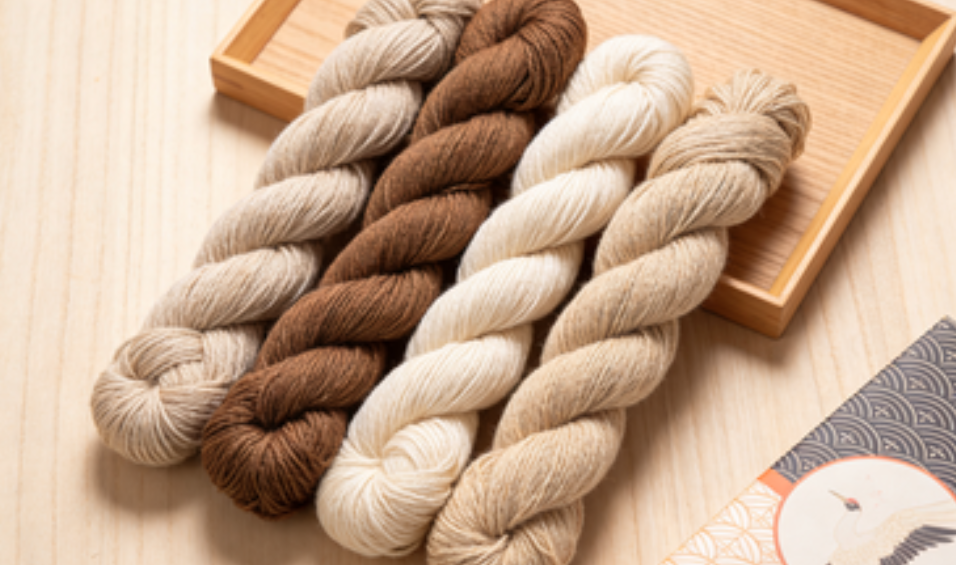
If you choose the wrong thread, the stitch becomes hard to see and you can easily give up. This is a common pattern for beginners as their “first stumbling wall.” If you correctly select the three key points—material, thickness, and color—you can almost eliminate that risk.
Characteristics and Suitability by Material
|
Material |
Features |
Suitability for bags |
|---|---|---|
|
Acrylic |
Affordable price, easy to see stitching, simple to wash |
◎ Optimal |
|
wool blend |
Easy to knit and relatively simple to care for |
◎ Optimal |
|
Wool |
Soft knitting feel and moderate stretch |
◎ |
|
Cotton |
Excellent breathability and absorbency |
△ Slightly difficult |
|
Linen |
It has a crisp texture and gloss. |
△ Slightly difficult |
For beginners, acrylic or wool blends are recommended. Cotton and linen have less slip, making tension management more difficult. It’s realistic to try the second work or later.
Summary | Let’s Graduate from ‘Not Enough Thread!’
The biggest regret in making crochet handbags is stumbling over the materials. By knowing the bag size, yarn thickness, and knitting pattern—these three things will help you know the required yardage. You only need to make a one-time purchase, making the journey to completion smooth.
To confidently start making crochet bags, first keep a conversion chart and a list by size on hand. Before you start knitting, try knitting a Tension Swatch piece. Just that alone can greatly improve the precision of the finished product.
He who controls the material controls the knitting.
The next step is simple. Decide on one design for the bag you want to make. Let’s calculate the required amount. All that’s left is to buy thread and hold the needle.
Recent Comments